A changing world is changing Orkney. One direction may bring new opportunities with energy or food production, and a climate of renewal. Another direction may lead to a kind of theme park, shaped by mass tourism and social media, and young people priced out of a home. There is no clear way ahead, just an uneasy sense of drift.
But other places have faced such situations and found a way through. The growth of industrialisation in 19th-century Norway opened up questions for its people: Who are we? Where are we going? And they found a solution: to select the essence of the past – in crafts, in house design, in language and dialect and attitudes to nature – and they integrated all these elements into their pattern of life, as a core for the future.
Orcadians seeking a yardstick for the past often turn to North Ronaldsay with its communally managed seaweed-eating sheep and the long stone dyke confining them to the shore. Orcadian readers follow events on the island through Ian Scott’s Letters from North Ronaldsay. And now through the energy and vision of Orkneyology Press the first decade of the letters have been brought into book form for readers everywhere.
Dancing to the summer dawn
It starts in 1990, the 70th anniversary of the Memorial Hall erected by the island’s laird in tribute to those who served and those who died in the First World War; and by August the accordions are playing, and the dancers are on the floor.
One ex-islander home on holiday, Tammie o’ Howatoft, now in his late seventies, intended to have, as he said, one more dance in the Old Hall, and then proceeded all night long. No doubt he remembered old times and will, as he said, remember this evening for the rest of his life.”
Outside in the evening sky the Merry Dancers are shimmering, and by the time for the cups of soup and Auld Lang Syne the light of the summer dawn has arrived.
Simmans and oil lamps
Just months later we’re back in the hall for the revival of the Harvest Home, and what a setting it is. There are simmans – straw rope and over 600 feet of it – and many other decorations from straw and hay and New Zealand flax; there are tables with candles and flowers, oil lamps hung from the roof. There is mutton from the native sheep, provided by Bertie Thomson and Billy Muir and cooked by Winnie Scott; and cheesecake with cream to follow, and cider for the meal and whisky for the toast. John Cutt gets the proceedings under way with the grace, and the address to the harvest is given by Bill Carstairs in fine form.
Then the tables are cleared and the floor dusted with Slipperine and the accordions of Lottie Tulloch and Ann Tulloch get the dancing under way, with Bill joining them on keyboards. There are songs by Billy and Ingirid Jolly, and music from former teachers Roy and Susan Russell and their family, back to visit. With tea, sandwiches and cakes as well, it is between four and five by the time the evening comes to a close, and on the way home past the War Memorial the Plough is in the sky.
There are so many fine nights to come as the Harvest Homes continue; then in 1996, the 200th anniversary of the birth of Robert Burns, the calendar of island events has a Burns Supper as well. It’s been encouraged by one of the Harvest Home speakers, Jim Anderson, Director of Education, and he’s there to address the haggis, piped in by Sinclair Scott, with Winnie Scott stepping in time to the music as she carries it round the hall. There are lanterns and candles, a portrait of the Bard with a lamp on either side – “ivy-capped and set against tartan” – and several hundred red roses, made by many helpers from crepe paper.

A prince will come
The New Community Centre hosts many events too, and the Burns Supper moves there, with high tensile wires and stack nets to reduce the hall’s height and carry the roses; and there are special occasions to welcome visitors, particularly when a fierce storm in 1993 flattens stretches of the sheep dyke. The Navy answers the call, and islanders and Navy men work together on the rebuilding, and then there is a dance to express warm appreciation for the visitors; and the momentum grows.
Well, even a prince came to see our sheep and sea dyke, and he was entertained in the New Community Centre, specially decorated with many examples of island work, plus a display by the school. Thanks must go to all those who helped prepare and lay out the magnificent choice of food, so grandly presented, and for all the work carried out on a voluntary basis. I wonder what the old sheepmen would have thought if they were still alive. I think, had they sampled a few drams of the ten-year-old malt whisky, very kindly donated by the Highland Park Distillery, they would have had quite a lot to say.”
And indeed past and present blend so seamlessly that we find ourselves stepping back and fore between them. Sometimes it’s with a funeral, such as that of Ronnie Swanney.
But it is the memory of Ronnie and his accordion that remains with those us who remember his swinging and exhilarating music – seated on the old stage, head back, sometimes with pipe in mouth, playing away back in the days when time was easy, summers seemed grander and more dancing feet carried the day.”
At other times it may be a historic occasion – as in 1998 when the lighthouse goes automatic and just before midnight the two local keepers carry out a ceremony to mark the end of an era. Billy Muir is piped in with the lighthouse flag, and almost on the stroke of midnight the pipes play again as James Craigie activates a flashing light system to symbolise the new mode of operation.


And a blackbird in the byre
There are welcomes for new teachers and reports of school trips and concerts. There are visitors with talks and slideshows, traditional dancing classes with Wilma Taylor, pantomimes for Christmas, bonfires on Turrieness Hill. Sometimes small things set off memories – a long-ago Christmas card in a house falling into ruin, a photo of man with a friendly smile, the song of a blackbird in the byre. There are memories of the old North Isles steamers, and of traditional lobster fishing in a North Ronaldsay praam, amidst rising lumps of water in the power of the ebb or flood. And there are passages where Ian paints with words as eloquently as he does with oil or watercolour.
I am finishing this letter to the sound of the northeast wind. Mists of drizzle are driving across the island. Along the exposed coast a line of white, broken sea is smoking away behind Breck and on past the two lighthouses. Days earlier, by contrast, the Merry Dancers had rippled in ever-changing colours of white and green across the northern sky. But the shimmering lights were the heralds of a southeaster, which came shortly afterwards and drove many creels ashore, damaged and tangled. In the far north the Greenland Eskimos of old used to think that those northern lights were the souls of their ancestors, playing at ball in heaven. This seems to me as fine and poetic a belief for those ghostly displays as ever one could imagine.”

At a friendly fireside
Indeed through the whole book there is a kind of continuity between past and present so that somehow all the people from different generations seem to be in a way present together in the island today. This comes through in stories of Hogmanay, with visits to the Standing Stone to dance around it, sometimes amidst snow flurries, and then warming up with drinks at a friendly fireside. Before rounding off with a memorable Hogmanay moment, I should specially mention the wonderful photographs, the sign of a true labour of love that this beautifully-produced book must have been for author and publishers alike, with Tom Muir’s deep understanding of tradition and story and his wife Rhonda’s own memories of falling under Orkney’s spell through reading Ian’s Letters in The Orcadian.
And now to complete the story here is Ian visiting the island’s oldest man at the start of 1996 and recalling together past Hogmanays in the days when houses were lit by Tilley lamps, amidst the pipesmoke of the older men.
We continued to talk about this and that, and stories of great Hogmanay and New Year nights. One concerned a neighbour, well fortified with North Ronaldsay ale, as all the company were as the night progressed, when he asked the local teacher (who was one of the company) if he could tell him what Heaven was really like. The answer he got was that probably that night he was as near to Heaven as he would ever be.”
From The Orcadian of 1 August 2024.
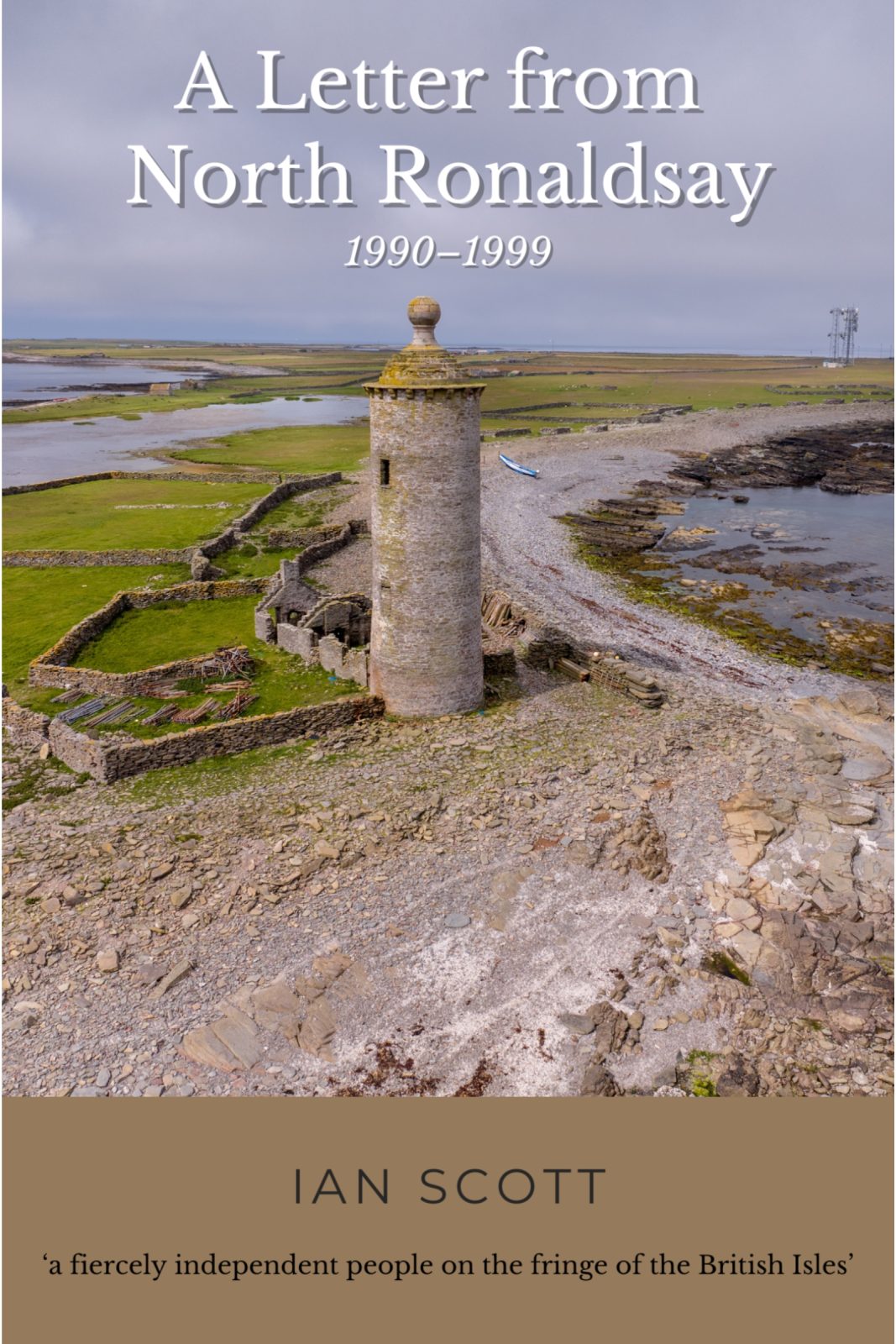
A Letter from North Ronaldsay 1990-1999 is published by Orkneyology Press and available direct from the publishers or from bookshops including The Orcadian Bookshop and Stromness Books and Prints.