

The Science Festival’s geology and landscape films are continuing to spread, with the new one from 2025, As Old as the Hills, going to be seen by an Edinburgh audience at the Edinburgh Geological Society on 18 March. Howie Firth looks at the story of the film from 2024, The Making of the Pentland Firth.
For a perfect hour on any Orkney visit, go for a walk around the west shore of Stromness. You follow the road up the hill behind the town, and the view begins to open up, out across to the hills of Hoy, their sides still showing the horizontal scars of an older time when ice flowed around them; and nearer at hand you see the smaller island of Graemsay, with its two lighthouses. Then you go down the hill to the old kirkyard by the sea. It is the resting-place of sea captains who went to Hudson’s Bay and round Cape Horn, and merchants like Alexander Stewart whose son George sailed with Bligh on the Bounty and died in the wreck of the Pandora off the Great Barrier Reef of Australia.
The shore has endless treasures and I remember once finding a sea mouse, a large sea slug that eats sea anemones whose stings are somehow transferred to the outside of its body in a protective screen. There is the sound of the sea and the light on the water – “a burning sapphire bough,” wrote the poet George Mackay Brown of a December day.


And if you walk down on the shore itself there are great slabs of rock you can step on, tilted at an angle like an immense stack of books. And that’s just what they are, say the geologists today, for the slabs of rock tell a story through time, page by page. They were once flat, formed from layers of sediment in a great lake, and then over millions of years as land and sea changed, they became layers of solid rock; and the tilt has to be a mark of some massive subterranean forces, earthquakes breaking up the rocks or an upwelling of hot lava upsetting the whole horizontal landscape.

A picture of an ancient lake
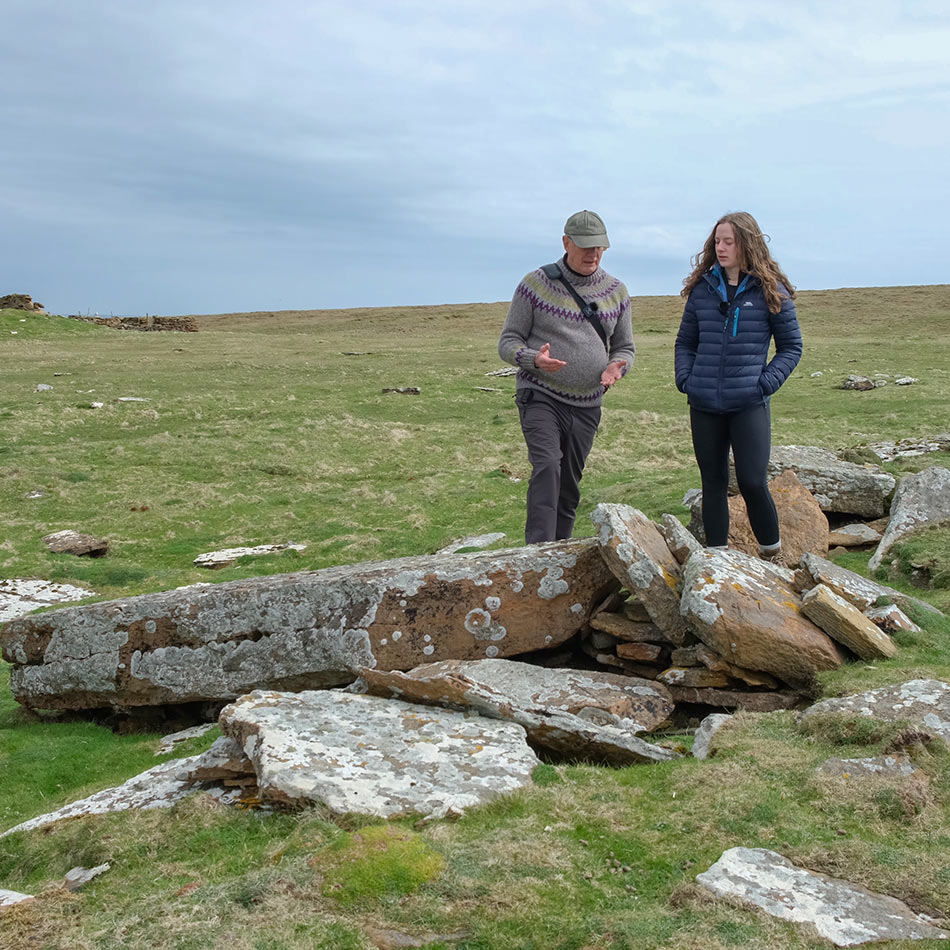
The perfect way to do this was to walk along the shore with the geologist Dr John Flett Brown. He could bring the whole story to life and take you back in time several hundred million years to a picture of a great lake that stretched out as far as the eye could see, and further still to the south of Shetland and down to the Moray coast. Out on the west was a mountain chain, of which today only two stumps remain – Suleskerry where the puffins nest in burrows in the turf and you have to watch out underfoot, and then Sule Stack with its great colony of gannets. But in the era of the ancient lake, no birds flew overhead, as this was a time before the first animals came out of the sea on to dry land on a journey that would lead to the development of reptiles and then birds.
When the Science Festival began, John was there to help it develop geological activities and to bring over the years some of his many friends and colleagues elsewhere. When Covid arrived and the necessity for online delivery, he took the opportunity to try a different format for a geology talk, filmed on local sites. He brought in a friend and colleague of many years, the Edinburgh-based geomorphologist Dr Adrian Hall. A collaboration developed with Moray-based artist and filmmaker Selena S. Kuzman, leading to the development of landscape websites as well.
The target for 2024 was to tackle the story of the making of the Pentland Firth; but in January of that year John died and left a huge gap. But we remembered the spirit in which he never gave up, and we were determined that his work and his vision would live on. We thought that Katy Firth from Stromness Museum would be an ideal co-presenter, with a background in communicating archaeology and geology and in subaqua diving as well, and we met Mara Gibb in Caithness, where she provides science support to primary schools from UHI; and we had a team all ready to go.

The emergence of the Pentland Firth
It was only comparatively recently in geological time that the Pentland Firth opened up, the result of an Ice Age glacier scraping a way through a potential channel between Caithness and Orkney. Adrian’s storyboard took us to sites in Orkney to see evidence of ice flow into the valley of Rackwick and to search for glacial erratics carried from the Northern Highlands. In Hoy we went to South Walls, and then northwards, to round off on the clifftop by the Old Man.
On the other side of the Firth, we saw in Caithness the actual marks of the glacier’s passage on bedrock, and then places where the effects of the sea’s power could be seen, and the way in which the land on the shores of the Firth had been eroded over time. There were visits to the Stacks of Duncanby and Dunnet Hear, to Gills Bay and Forss and Reay.


And we had a wonderful Stroma visit, welcomed by the island’s owner, William Simpson. If you haven’t been there, you might think that the island has an air of sadness about it, with its cottages abandoned and going into ruin, and the feeling of the end of an old song. Not at all – you step on the pier and walk up the grassy road and there you are at the highest point of the island with a panoramic view of the Firth and the ships moving by and you feel in the middle of a flow of activity.
The sight of the great whirlpool, the Swelkie, is one of the powerful images of the natural world that the island shows, and the great Gloup is another, a seacave where the roof has fallen in, so that it is like a hold in the ground with the sea opening up below. There is a smaller gloup further inland. We went to Stroma to see at first hand the sheer power of the sea, and to look for the evidence that can still be seen of the great storm of 1862 when the sea swept over the north end of the island and the waves rose up the 200-foot vertical cliffs and deposited stones and seaweed. The waters were said to have rushed in torrents across the island, “tearing up the ground and rocks in their course towards the old mill at Netherton on the opposite side.”
So while the ice cut the channel for the Pentland Firth, the power of the sea shaped it and continues to do so, sometimes in a sudden fall of rock and at other times over long slow ages of time.



Adapted from an article first published in the December 2025 Bulletin of Moray Field Club. This issue has a range of fascinating features ranging from the story of the marine artist Peter Anson to the origins of the various bridges across the River Lossie, There are insights into the life of Robert Reid, the 16th-century Abbot of Kinloss who went on to become Bishop of Orkney, and also the first results of a new wildlife observing project.


