The 2024 Orkney International Science Festival marked the 50th anniversary of the death of the Orkney writer Eric Linklater. His novel The Dark of Summer, published in 1956, has a fresh picture of the nature of time that remarkably appears at the frontiers of physics today. The anniversary was an opportunity to explore the vision itself and the nature of a writer whose work spans so much of Orkney’s life and landscape.
At first glance Eric Linklater might have seemed the essence of the Establishment, and he had all the qualifications. He served in two world wars, reaching the rank of captain and later for a time lieutenant-colonel in the Korean War. He was a highly successful writer, earning enough from his work to maintain a country house and family, and he knew people at all levels of society. But through his life was a polarity that took him between two worlds – between home comforts and new journeys abroad, between Orkney farming firesides and Edinburgh sitting-rooms, and between tales of modern-day adventures and stories that went deeper into other levels of existence. At the heart of his short story Sealskin Trousers is the old Orkney legend of the shapeshifter who was a man upon the land and a selkie in the sea. “We have some advantages over human beings, you know,” says the man who is about to make the transition back to the sea.
Human beings have to carry their own weight about, and they don’t know how blissful it is to be unconscious of weight: to be wave-borne, to float on the idle sea, to leap without effort in a curving wave, and look up at the dazzle of the sky through a smother of white water, or dive so easily to the calmness far below and take a haddock from the weed-beds in a sudden rush of appetite.”
At first glance Eric Linklater might have seemed the essence of the Establishment, and he had all the qualifications. He served in two world wars, reaching the rank of captain and later for a time lieutenant-colonel in the Korean War. He was a highly successful writer, earning enough from his work to maintain a country house and family, and he knew people at all levels of society. But through his life was a polarity that took him between two worlds – between home comforts and new journeys abroad, between Orkney farming firesides and Edinburgh sitting-rooms, and between tales of modern-day adventures and stories that went deeper into other levels of existence. At the heart of his short story Sealskin Trousers is the old Orkney legend of the shapeshifter who was a man upon the land and a selkie in the sea. “We have some advantages over human beings, you know,” says the man who is about to make the transition back to the sea.
…for they had partners who had come from nowhere, who led them first to the right and then to the left, up the middle and down the sides, bowing, and knocking their heels in the air. As the tune quickened, they turned themselves head over heels, even Mrs Pomfret, who held her sides and laughed to see old Pomfret twirling on one toe. And the gramophone never stopped, for a little brown man was sitting by it and now and again turning the handle, and singing loudly as he sat.
So they danced while the sky became lighter and turned from grey to a shining colour like mackerel; and then little clouds like roses were thrown over the silver, and at last the sun himself, daffodil gold, all bright and new, shot up and sent the other colours packing.”
There are descriptions of raw magical power that emerge out of apparently casual conversations in places like the deck of the steamer with passengers for Aberdeen, out in the open with a sea and sky.
Mr. Pinto, remarking that it seemed to be a fine night, stepped out on to the deck.
‘Oh, a glorious night,’ said the young man with the beard, following him. ‘Look at the clouds, like grey foxes running from the moon.’
‘Indeed, there is one extraordinarily like a fox,’ replied Mr. Pinto politely.
‘She is hunting to-night.’ Said the young man. ‘Foxes and grey wolves. And see, there’s a stag in the west. A great night for hunting, and all the sky to run through.’ “
In The Dark of Summer the cares of this world hang heavily over the story, and the book was published at a bleak time, the autumn of 1956, a time of conflict in Eastern Europe and the Middle East. This was the time when Soviet tanks rolled into Hungary to crush a short-lived revolution, and when Britain and France attacked Egypt to try to seize the Suez Canal. Both of these crises developed from a long chain of events and the narrative of the book describes how events can carry us in their flow, like leaves borne by a river. It builds up to a remarkable insight, and we were joined in Kirkwall for the story by Dame Janet Suzman, one of Britain’s greatest Shakespearian actresses and a lifelong family friend of the Linklaters. She read extracts from the book, leading up to the narrator’s extraordinary vision of the flow of time – from the future.
If you cannot view the video in your browser you can also access it directly on the Festival’s Facebook post.
Remarkably, several approaches to deep and fundamental problems in physics today involve rethinking the nature of time and the image that has lasted from the time of the ancient Greeks, for more than two millennia – of time as a river flowing downstream and carrying everything along in its flow. This was developed in the 19th century into the concept of ever-increasing disorder, or entropy, and much of physics became shaped around it. But a counter-argument developed in 1940s Italy, when the mathematician Luigi Fantappié suggested that entropy is not alone and all-powerful, continually breaking down order. There is, he said, something else present, something that builds up order, including living systems, and he named this syntropy. Eric Linklater reached a similar conclusion – that there is a flow of time from the future, into which we swim upstream, shedding our yesterdays and able to make each day new.
Dame Janet’s visit was to lay flowers on the grave of another glittering talent in the Linklater family – Kristin, daughter of Eric and his wife Marjorie, who in a career of more than fifty years in the US became professor at Columbia University and one of the great acting teachers, training many well-known names. In 2013 she retired to Orkney to realise a dream, with the establishment of her voice centre in Quoyloo.
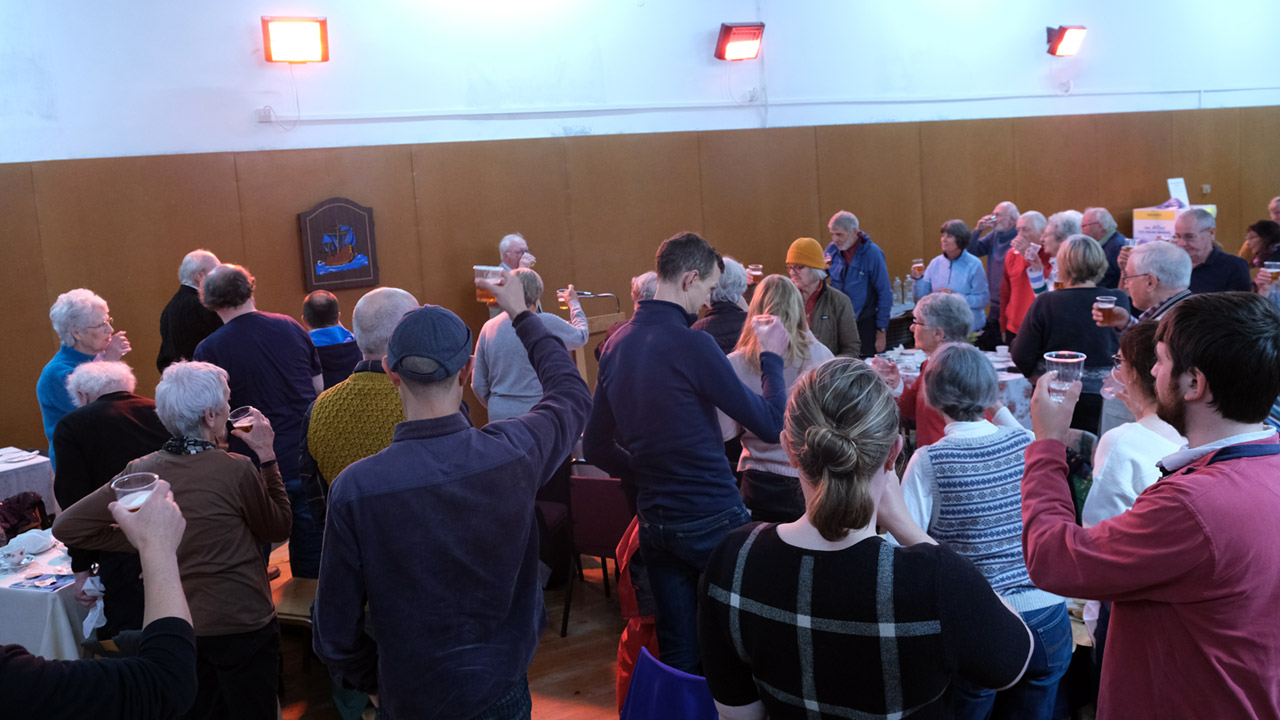
Kristin was the subject of the One O’Clock Toast at the lunch of Orkney fare that day at the Peedie Kirk in Kirkwall. It was eloquently given by her brother Magnus.
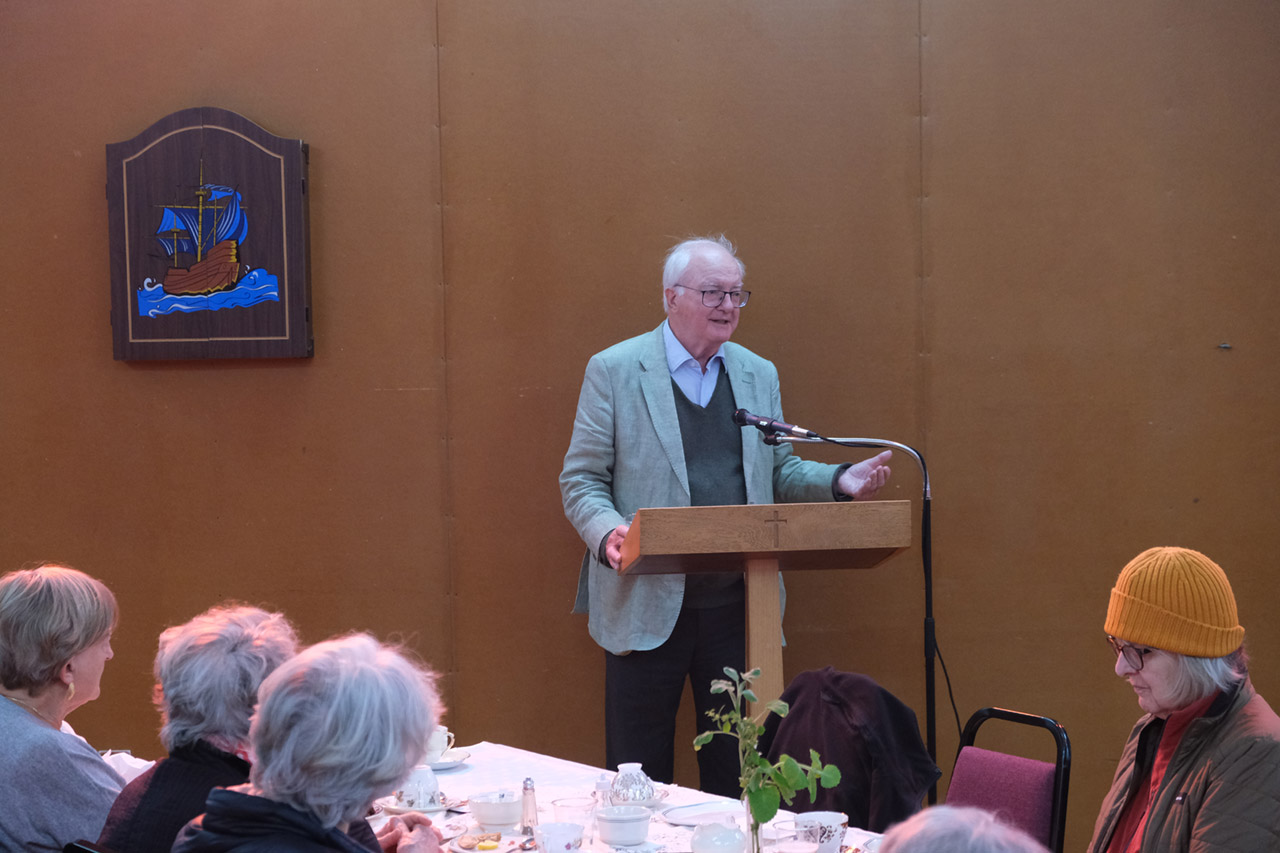
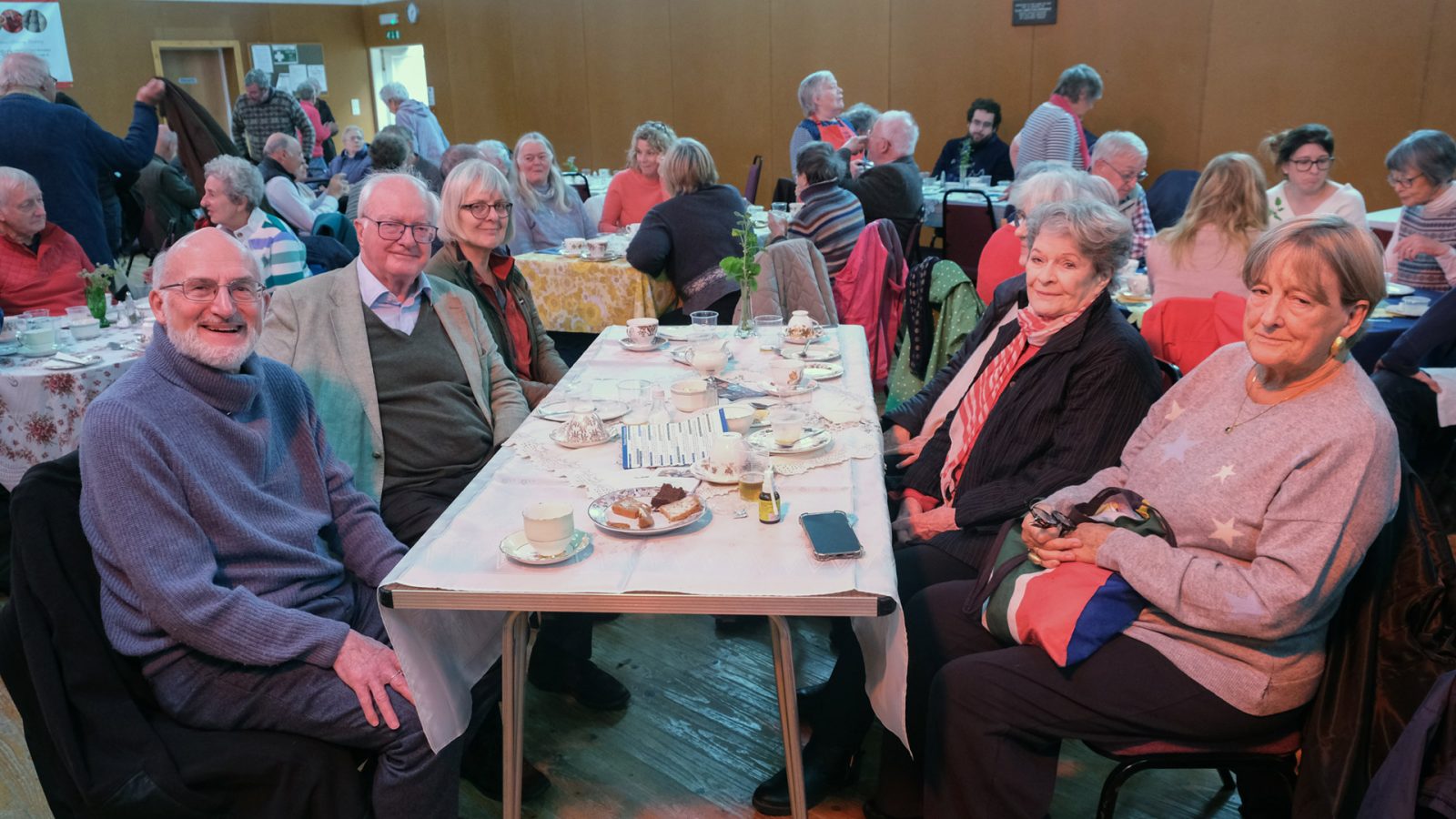
The day was rounded off by Magnus himself, looking back in conversation at the lives of his parents and of Kristin, and their brother Andro and sister Alison (Sally). Magnus himself is one of Britain’s most distinguished journalists, in a career which has included senior editorial roles at the Sunday Times and the editorship of The Scotsman. In a wide-ranging discussion he was asked about what over the years he had seen could be journalism at its best.
If you cannot view the video in your browser you can also access it directly on the Festival’s Facebook post.
Somewhere in that landscape lies a spell,” wrote Eric Linklater in the concluding sentence of his picture of Norse Orkney, The Ultimate Viking, “and the spell has not lost its power.” The whole Linklater family have added so much to the richness of the enchantment.